ScaleMind Consulting
AI-Powered Business Solutions
Published
Automating client onboarding: a live website into a managed platform.
The fastest way to lose a client during a website migration is to show them their own site rebuilt into somebody else's template. The design they paid for is gone, the URLs have moved, and the promise of "a CMS you can edit yourself" has quietly become "a different website you can edit yourself."
SiteMaker is our answer to that problem: a multi-tenant publishing platform, built in-house at ScaleMind, that takes a live website — any stack, any builder, any age — and turns it into a fully managed, editable site that still looks exactly like itself. Not approximately. Verified, screenshot against screenshot, at the pixel level.
The site you are reading is served by it right now.
The problem: every client website is a snowflake
Traditional content management systems solve editing by owning the design: pick a theme, pour the content in, accept the compromise. That trade is backwards for a consultancy. Our clients already have designs — sites they have invested in, that their customers recognise, that rank in search. What they lack is the ability to edit them without a developer, and an owner for the unglamorous machinery underneath: hosting, TLS certificates, image management, analytics, publishing.
Migrating those sites by hand is the standard answer, and it is a poor one. A hand migration is slow, it drifts from the original in a hundred small ways nobody signed off on, and every site becomes a bespoke project with a bespoke maintenance burden.
So we set out to automate the onboarding itself.
What we built
A platform that learns each site's language
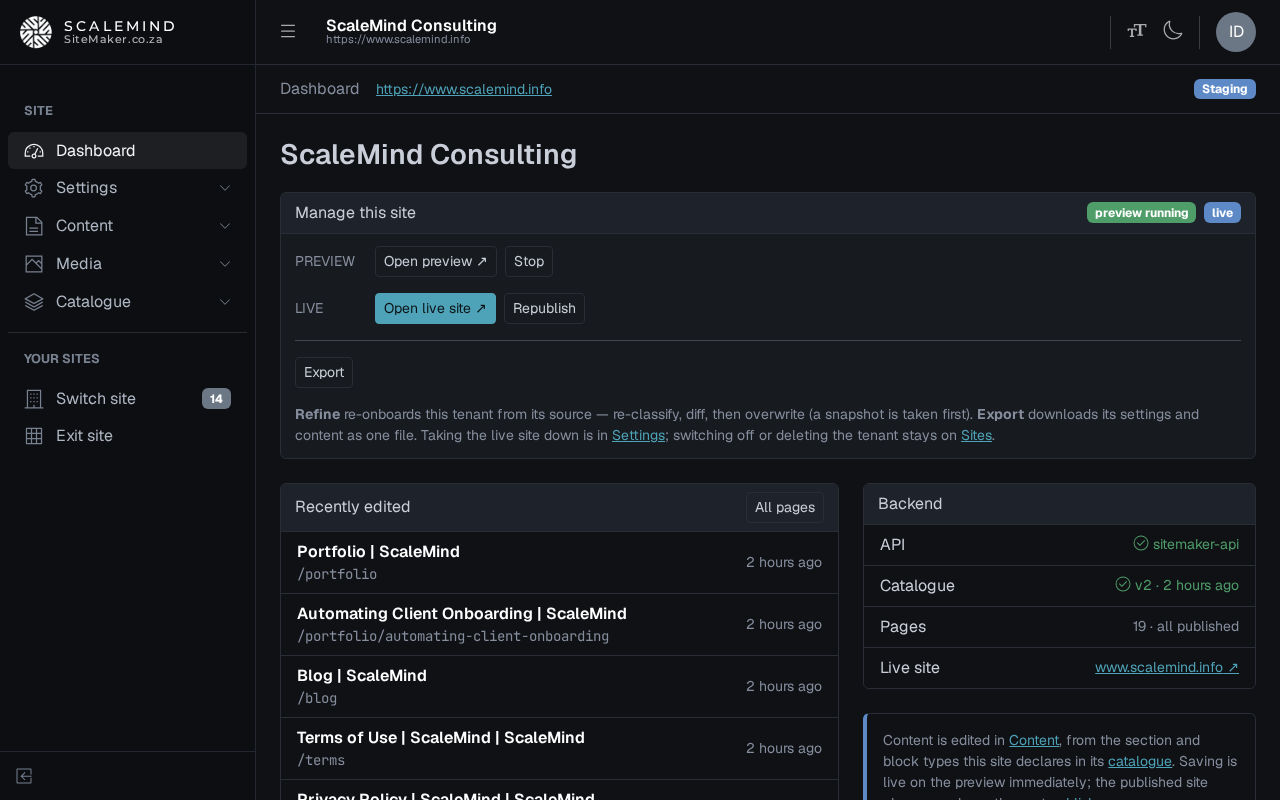
Most CMSs make the site speak the CMS's language. SiteMaker inverts that: every site publishes a small machine-readable catalogue describing what it can render — its own sections, its own fields, its own vocabulary — and the editing interface builds itself from that document at runtime. The platform ships with no assumptions about what a page contains, which is precisely what lets it manage fourteen very different sites today without a line of per-site code in the platform itself.
The practical consequence for a client: the editing screens speak their site's language. The fields they see are the fields their design actually has.
Onboarding by URL
Adding a site starts with pasting its address. From there, an automated pipeline — driven by an AI agent working to a fixed, version-controlled recipe — captures the live site, rebuilds it as a modern web application, imports its content into the platform, and then proves the result: the rebuilt pages are screenshotted side by side with the originals and compared. Several of our reproductions have verified with zero pixel difference at desktop width; nothing ships until a human has reviewed that evidence.
The pipeline also collects what a migration usually forgets. Favicons and app icons are captured into the media library. The site's social-sharing images and descriptions are carried over. An existing Google Analytics or Tag Manager installation is detected and re-created from its measurement ID — deliberately rebuilt rather than copied, so the tag arrives clean, documented and editable. A page-scanning automation then sweeps every published page for media the migration might have missed — a logo served from the old build, a background image, an icon set — and brings each file into the library so the client owns their assets outright.
Editing that is live, and publishing that never interrupts it
Every site on the platform runs two deployments at once: an editable preview on its own address, and the published site on the client's real domain. Edits appear on the preview immediately — the editor clicks an element on the page and edits it in place. Publishing builds the site for production and swaps it in behind the scenes; the preview keeps running throughout, so an editor mid-sentence never notices a deploy. Custom domains, the www/non-www pair, TLS certificates and redirects are provisioned automatically from a settings screen.
The proof: this site
We ran the whole story on ourselves. scalemind.info began life on a website builder, with its blog held in a proprietary hosted CMS. Onboarding it to SiteMaker meant reproducing the design faithfully, then cutting the last dependencies: nine blog articles were exported, converted, and re-imported as first-class pages; every cover image was re-hosted into the media library; the blog and this portfolio became dynamic indexes that update themselves when a new article is published; the analytics tag moved out of hard-coded markup into managed settings. The builder subscription is gone, and nothing about the site's face changed.
That is the test we hold the platform to: if the migration is done right, the only people who can tell are the ones who now find editing easy.
Results
- Fourteen sites currently managed on one platform, each keeping its own design and vocabulary
- Same-day onboarding from pasted URL to a published, editable site for a typical marketing site
- Pixel-verified fidelity — reproductions reviewed against screenshot evidence, several at zero-pixel difference
- Zero platform changes per site — onboarding a new client touches no platform code, by design and by automated check
- Instant editing, uninterrupted publishing — live preview edits, production deploys that never take the editor offline
- Owned assets — images, icons and analytics carried into infrastructure the client controls
Under the hood
The platform pairs a Python API with server-rendered React sites, backed by MySQL, with automated provisioning for hosting, certificates and per-site deployments. The onboarding agent runs a versioned, auditable recipe — the same recipe every time — so a reproduction is a repeatable process, not a heroic effort.
SiteMaker is the engine behind ScaleMind's managed-website work. If you have a site you love but can no longer edit — or a builder subscription you would like to retire without losing your design — talk to us.